
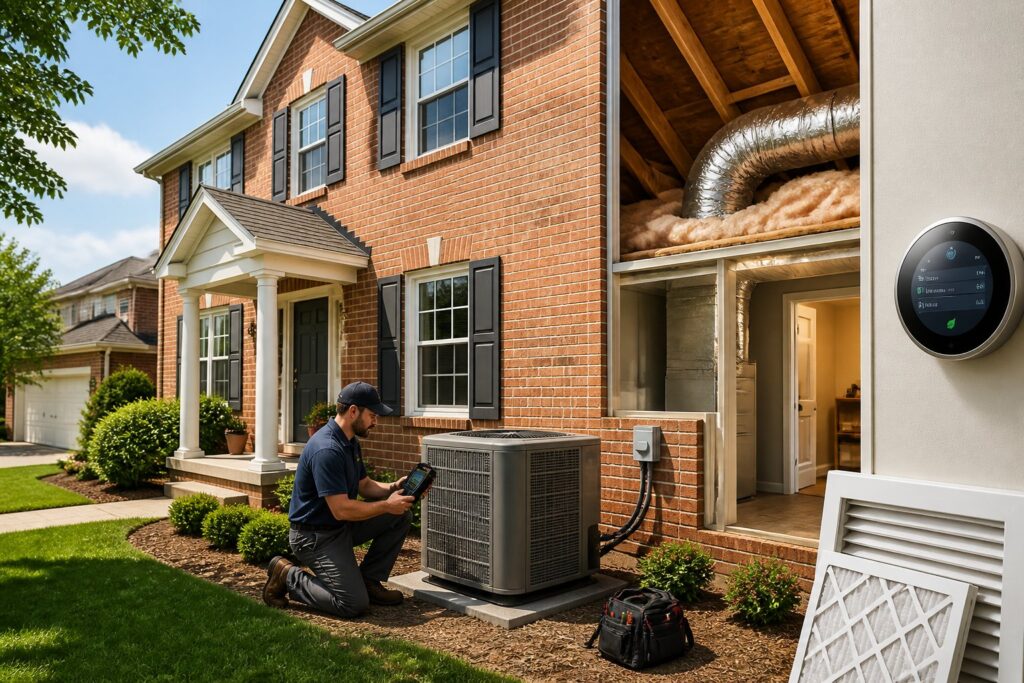
How to improve HVAC efficiency in brick homes starts with understanding that the house itself affects how your system works. Brick can hold heat longer than lighter-framed construction, which can help comfort in some conditions and work against you in others, especially during Michigan’s cold winters and humid summers.
If your home feels drafty, slow to warm up, or uneven from room to room, the building shell may be part of the problem, not just the furnace or air conditioner.
The best way to improve energy efficiency in brick homes is to seal air leaks first, then improve insulation in a way that fits the wall assembly. Choose HVAC equipment that matches the home’s age and layout.
That approach helps the system do less work, which can lower bills and improve comfort.
Key Takeaways
- Air sealing often gives the fastest comfort gains.
- Brick walls need insulation choices that manage moisture carefully.
- The right HVAC upgrade depends on the home’s layout and age.
Why Brick Homes Need A Different Efficiency Strategy
Brick homes behave differently because masonry stores and releases heat more slowly than many other wall types. That thermal mass can help stabilize indoor temperatures, yet it can also delay how quickly a home responds when the weather changes fast, which is common in Michigan.
How Thermal Mass Changes Heating And Cooling Behavior
Thermal mass gives brick walls the ability to absorb heat during the day and release it later. That can smooth out temperature swings and support steadier comfort, especially in rooms that get direct sun.
It also means your heating and cooling system may need more time to bring the home back to a set temperature after setbacks.
Where Brick Helps Comfort And Where It Can Work Against Efficiency
Brick can improve thermal performance when the whole assembly is designed well, since masonry can buffer short-term temperature changes. In homes with weak insulation or lots of leakage, though, the same heat capacity can hide inefficiencies until your utility bills rise.
That is why historic brick homes often need a full-building approach instead of a simple equipment swap.
Why Michigan Weather Makes Performance Gaps More Noticeable
Freeze-thaw cycles, lake-effect cold, and humid summer stretches put extra stress on masonry walls and HVAC systems. When temperatures swing quickly, brick can lag behind the indoor setpoint, which makes comfort gaps easier to notice.
In Southeast Michigan, that often shows up in older homes across Bloomfield Hills, West Bloomfield, Birmingham, Farmington Hills, Novi, Livonia, Auburn Hills, and Troy.
Seal Air Leaks Before Upgrading Equipment
Air sealing is usually the first place to start because heating and cooling systems cannot perform well if conditioned air escapes. Tightening the building envelope can reduce air infiltration, improve comfort, and make every later upgrade work better.
Common Air Leakage Points Around Windows, Doors, Attics, And Floors
Look for air leaks around window trim, door frames, attic hatches, rim joists, and areas where floors meet exterior walls. Small gaps around masonry transitions, chimneys, and utility penetrations can also matter more than they seem.
In brick homes, older joints and mixed-material connections are common leakage spots.
How Air Infiltration Raises Heating And Cooling Costs
Air leakage forces your furnace or air conditioner to condition outside air that keeps entering the home. That raises runtime, increases wear, and can leave rooms feeling drafty or uneven.
Even modest leakage can make a brick house feel harder to heat and cool, especially on windy winter days.
Low-Impact Fixes Like Weatherstripping And Door Sweeps
Weatherstripping, door sweeps, caulk, and foam sealant can deliver fast gains without major disruption. These fixes are low cost, and they often improve comfort right away.
If you are planning larger HVAC work later, sealing first helps the new system operate more efficiently from day one.
Improve The Wall And Attic Assembly Without Trapping Moisture
The goal is to make the wall assembly more efficient without creating moisture problems inside masonry walls. That means thinking about insulation, r-value, vapor control, and thermal bridging together, not as separate fixes.
How Insulation, R-Value, And Brick Work Together
Brick adds thermal mass, while insulation adds resistance to heat flow. In a good wall assembly, those parts work together so the home loses less heat in winter and gains less heat in summer.
When the insulation layer is weak or incomplete, the brick alone cannot make up the difference.
When Fiberglass Insulation Helps And When Continuous Insulation Is Better
Fiberglass insulation can help in attics and some framed portions of older homes, especially when there is enough space to install it properly. Continuous insulation is often a better fit where you want to reduce thermal bridging across studs, rim joists, or other framing members.
In masonry walls, the right choice depends on the construction, the climate, and how the layers will dry.
Moisture Risks In Masonry Walls, Vapor Barriers, And Thermal Bridging
Brick homes can trap moisture if insulation is added in the wrong place or if a vapor barrier blocks drying where the wall needs it. Thermal bridging can also reduce the real-world r-value of the assembly by letting heat move through framing and masonry connections.
A careful approach protects the wall while improving energy performance.
Choose HVAC Upgrades That Fit Older Brick Construction
Older brick homes often need compact, flexible equipment that works with limited duct space and uneven room loads. The best upgrade is usually the one that matches the home’s structure, not just the highest efficiency rating on paper.
Right-Sizing Furnaces And Air Conditioners For More Stable Performance
A properly sized furnace or AC runs more steadily, controls humidity better, and avoids short cycling. That matters in historic brick homes, where temperature swings can already be slower to correct.
If the system is oversized, you may get louder operation, less even comfort, and wasted energy.
Why Ductless Mini-Split Systems Work Well In Hard-To-Modify Homes
Ductless mini-split systems can be a strong option when adding ductwork would be difficult or invasive. They give you zoned comfort, which helps when different rooms in a brick home have different heating and cooling needs.
They also pair well with targeted upgrades in homes where preserving finishes matters.
When Radiant Floor Heating Makes Sense In Renovations
Radiant floor heating can make sense during larger renovations because it delivers heat evenly and works well with masonry’s heat-storing qualities. It is especially useful in spaces where comfort and quiet operation matter.
For some brick homes, it can be a smart supplement to a main HVAC system rather than a full replacement.
Use Testing And Maintenance To Protect Long-Term Performance
Testing and maintenance help you keep gains from slipping away over time. A professional energy audit, regular service, and timely masonry repairs can protect thermal performance and keep your system from wasting energy.
What A Professional Energy Audit Can Reveal
A professional energy audit can show where air leakage, insulation gaps, and weak spots in the building envelope are hurting efficiency. It can also help you prioritize the biggest comfort and cost issues first.
That is especially useful in brick homes, where the problem is often a mix of shell performance and HVAC performance.
How Maintenance Supports Efficiency, Airflow, And Indoor Air Quality
Regular filter changes, blower checks, coil cleaning, and thermostat calibration help the system move air the way it should. That supports efficiency, improves airflow, and can reduce strain on indoor air quality.
In humid Southeast Michigan summers and dry winter heating seasons, that maintenance matters more than many homeowners realize.
When Masonry Repairs Help HVAC Results
Repointing damaged mortar, repairing cracks, and fixing water entry points can improve the home’s ability to hold conditioned air and resist moisture problems. If masonry is letting in water or outside air, HVAC equipment has to work harder to compensate.
Addressing the shell first can make heating and cooling upgrades more effective and longer lasting.
Frequently Asked Questions
Why does my brick house feel harder to heat and cool than other homes?
Brick homes often have more thermal mass, so they respond more slowly to temperature changes. If the home also has air leaks, weak insulation, or older equipment, that slow response can feel even more noticeable during Michigan weather swings.
What insulation upgrades make the biggest difference in an older brick home?
Attic insulation and air sealing usually give the largest comfort and efficiency gains first. For wall work, the best upgrade depends on the masonry walls, moisture behavior, and how much of the home you are renovating at one time.
How can I find and seal air leaks around windows, doors, and brick walls?
Start with weatherstripping, door sweeps, and careful caulking around visible gaps. A professional energy audit can also help identify hidden air leakage points near rim joists, attic accesses, and masonry transitions.
Would a ductless mini-split heat pump work well for a brick house layout?
Yes, especially if your home has limited ductwork or rooms with uneven comfort. Ductless mini-split systems are a practical fit for many older brick homes because they provide zoned control without major structural changes.
When should I consider replacing my current system with a high-efficiency Lennox AC or heat pump?
Replacement makes sense when your current system is aging, repairs are becoming frequent, or comfort is still poor after basic sealing and maintenance. A high-efficiency system can help, yet it works best when the building envelope is already tightened up.
What duct sealing and airflow fixes can improve comfort and reduce energy bills in a brick home?
Sealing accessible duct joints, balancing airflow, and checking for leaks in unconditioned spaces can make a noticeable difference.
If some rooms stay too hot or too cold, duct sealing plus airflow adjustments can improve comfort without replacing the whole system.
